

Election Results Are In: What Could They Mean for Investors?
Election season often brings a familiar question for investors: What does this mean for the markets?
With the 2026 midterm elections largely decided, Democrats are projected to take control of both the U.S. House of Representatives and Senate. That changes the political landscape in Washington and will likely put greater emphasis on negotiation between Congress and the Trump administration over the next two years.
For investors, however, the more important question may not be which party controls Congress. Instead, it may be how much weight political developments should carry when making long-term investment decisions.
History offers some helpful perspective.
A New Political Landscape
Changes in control of Congress can affect the direction of tax policy, regulation, government spending and other issues that influence businesses and the economy.
At the same time, the United States continues to operate as an open, market-driven economy. Public companies still compete for customers, develop new products, invest in technology and pursue growth regardless of which party controls Washington.
That distinction matters.
Government policy can certainly influence markets, industries and individual companies. But political control is only one factor affecting investment returns. Interest rates, inflation, economic growth, corporate earnings, productivity, technological innovation and global events all play important roles as well.
Midterm Elections Have Historically Brought Volatility
Investors may understandably feel unsettled when markets and politics become volatile at the same time. But volatility during a midterm election year is not unusual.
Looking at the graph below from First Trust, the S&P 500 experienced an average maximum drawdown of 16.2% from the beginning of a midterm election year through Election Day between 1950 and 2024.
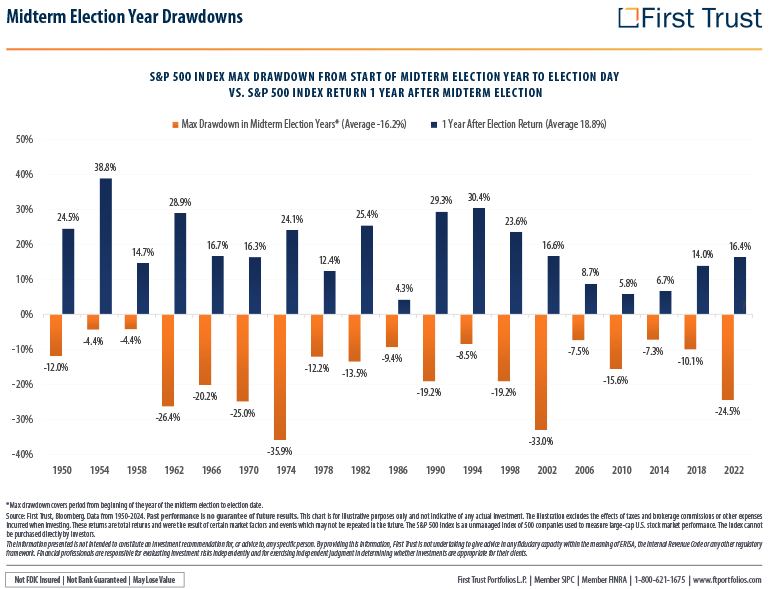
What happened afterward is also worth noting.
Over the one-year period following those midterm elections, the S&P 500 produced an average return of 18.8%.
Of course, past performance does not guarantee future results. The lesson is not that the market will rise simply because an election has passed.
Instead, history demonstrates how difficult it can be to make investment decisions based on political uncertainty alone.
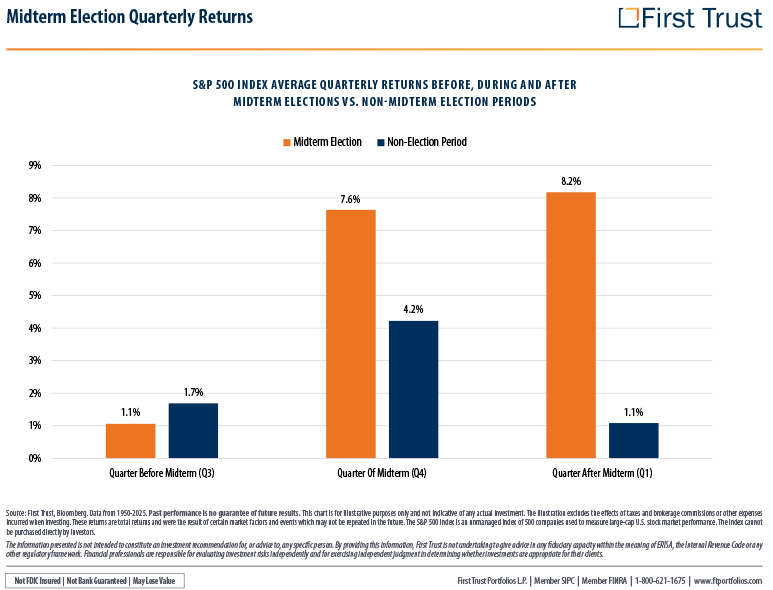
Markets Have Endured Many Political Environments
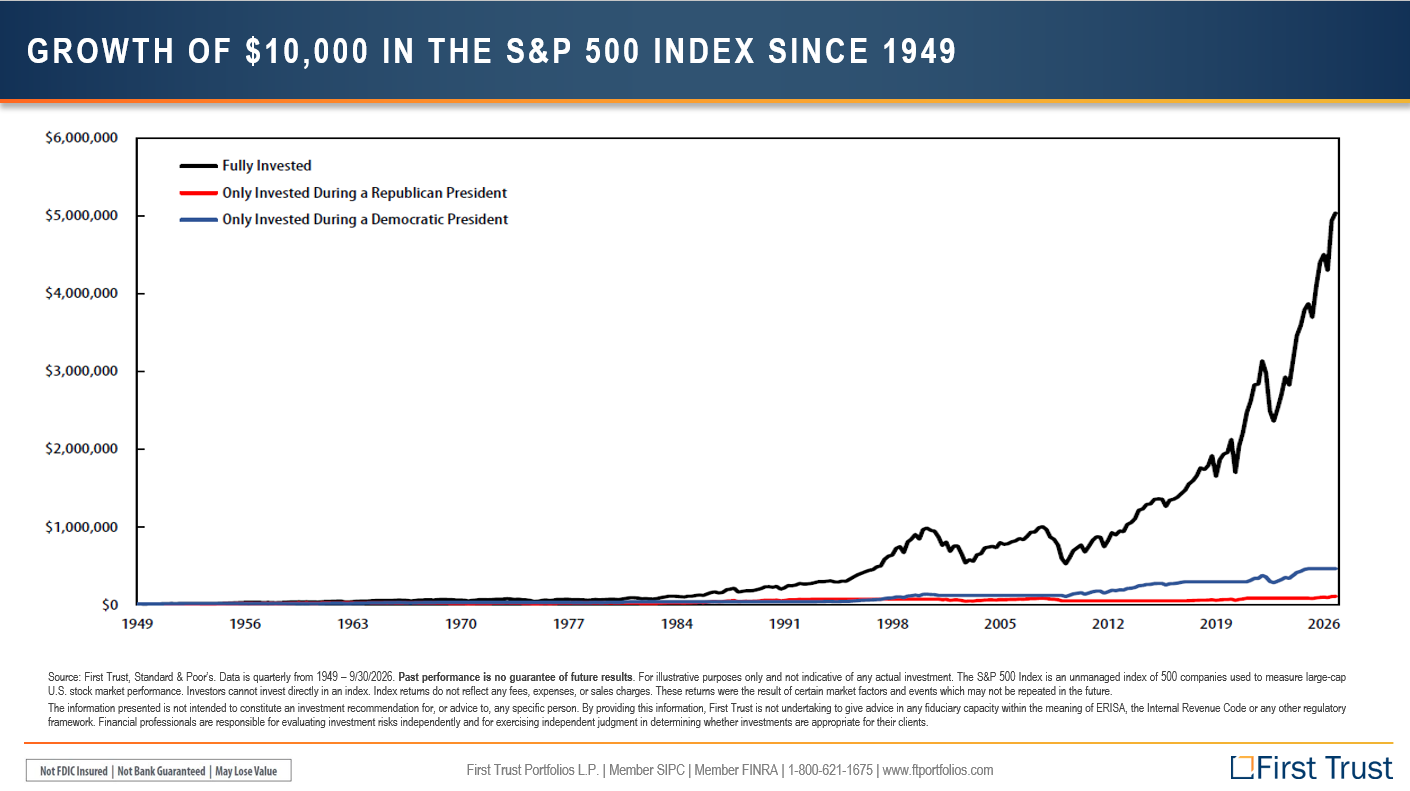
It is easy to look at an election result and assume a particular party or policy will be either good or bad for the stock market. History has been much less straightforward.
The long-term market data illustrates just how much markets have grown through decades of changing political leadership and very different economic environments.
What Should Investors Do Now?
There may certainly be investment implications from the policies pursued by the new Congress and administration. Those developments deserve attention.
But reacting to an election result by making broad changes to a portfolio can create another risk: allowing short-term political expectations to override a long-term financial strategy.
Rather than asking, “What should I buy or sell because of the election?” we believe investors may be better served asking:
- Has anything changed about my long-term financial goals?
- Has my investment time horizon changed?
- Is my portfolio appropriately diversified?
- Am I taking an appropriate amount of risk?
- Are there tax or planning opportunities created by current market conditions?
- Does my financial plan still reflect where I am today?
Those are questions that can be acted upon regardless of which party controls Washington.
Keeping Politics and Portfolios in Perspective
Elections matter. Policy matters. And the composition of Congress can influence the economic environment in meaningful ways. But history also reminds us that political change is a normal part of investing, not necessarily a reason to abandon a long-term investment strategy.
At Evergreen Wealth, our focus remains on helping clients build financial plans and investment strategies around their goals, time horizons and individual circumstances rather than trying to predict the market's reaction to the next political headline.
As Washington enters a new chapter, we will continue monitoring potential tax, regulatory, economic and investment implications. If the election has you wondering whether your portfolio or financial plan should change, we welcome the opportunity to talk through it with you.